System Apocalypse
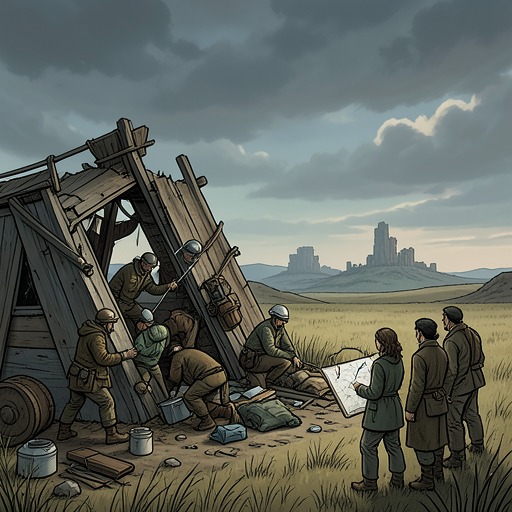
Systema Delenda EstSystem Apocalypse is the catastrophic arrival of the System, the force that remade Earth and numerous other worlds through game-like physics, technological collapse, monsters, enforced progression, and mass death. Its decisive significance is double-edged: the System destroys existing civilizations, yet on some worlds it also supplies the first reliable food, language, industry, and social order their inhabitants have ever known. The event therefore becomes not merely an invasion to repel but a historical condition that different peoples remember as genocide, uplift, salvation, or an oppressive bargain.
Arrival and Immediate Devastation
System Apocalypse begins when the System comes to Earth and conventional technology fails. Monsters appear, humanity is inducted into the game-like physics the System enforces, and billions die. The scale of the disaster makes it unlike an ordinary military defeat: it attacks the material infrastructure of civilization, the assumptions of physics, and the continuity of human life at once. Later descriptions emphasize that the dead were not only casualties of war. When servers failed and cybernetic implants turned inert, billions could be erased from existence almost instantly, making the System's collapse potentially apocalyptic in its own right.
The devastation also carries an ecological dimension. The System's damage threatens every form of life on an affected world, including birds, fish, villages, and kingdoms. Its violence is therefore not confined to populations that resist it or to strategic targets. It reaches through food systems, habitats, political institutions, and the ordinary conditions that allow a world to remain inhabited. The destruction of Earth is remembered as the clearest example, but the same pattern had already occurred on Sydea, perhaps hundreds or thousands of years earlier.
Different Worlds, Different Apocalypses
The meaning of the event depends on what the System encounters. Cato remembers Earth as a ruined home whose simulated worlds and familiar places vanished with the System's advent. He was born after the War of Outsystem Independence, but he had friends on Earth and had spent time in its simulated worlds; those memories became all that remained after the System erased them. This personal connection explains why he rejects the outsystem consensus that Earth had deserved its fate and why his later campaign treats the System's arrival as a crime requiring both resistance and accountability.
Initik's memory presents an unsettling contrast. When Cato asks whether he remembers his System apocalypse, Initik recalls not a civilization collapsing but hunting prey when the System's words appeared before him. The System gave him language, ended hunger, and relieved the Urivans of wandering the plains in search of food. For Initik and the Urivans, the arrival destroyed little beyond a proto-language and moved their society abruptly toward a pre-industrial condition, perhaps farther. In that local context the System seemed like an unquestionable improvement, even though its later structure became a suffocating dead end. The same force that annihilated Earth could therefore appear elsewhere as an unprecedented gift.
Other worlds occupy positions between those extremes. The System reached one maritime civilization in the middle of its age of sail, leaving its king to face three weeks of disasters before Cato arrived. On another incursion, the System collapsed only days after Cato passed through, either because the connection had been severed before the System could establish itself or because an isolated planet could not sustain the connection. These variations show that System Apocalypse is not a single uniform blast but a recurring process shaped by local development, connection, duration, and dependence.
Cato's Response and the Counter-Invasion
Cato joined the early volunteers after someone on Titan discovered that exotic biology projects worked where conventional technology did not. He descended toward Earth in search of his aunt's family, entering a conflict in which survival required a particular mental attitude. Remote command was impossible because of the time lag to the ground, while any individual risked permanent death. Volunteers who could not accept multiple copies of themselves, or could not stomach the possibility that a version of themselves might be annihilated without reintegration, quickly withdrew.
This background makes the later counter-invasion a response shaped by the System's own rules. Cato does not simply seek to cut the System's legs out from under it. He recognizes that removing the System without preparation could produce another apocalypse, although less drastic than its arrival on Earth. His objective is to reverse the original catastrophe without killing the millions living on Sydea. The distinction is central to his campaign: defeating the System is insufficient if victory destroys the people who have been forced to depend on it.
Cato's preparation combines biological experimentation, warframes, genetic-engineering archives, industrial expansion, and communications systems designed to evade System detection. He works as hard as Raine and Leese, even while remaining above the surfaces of System planets, testing bioweapons and frames, recovering obscure projects from vast databases, and administering industrial infrastructure across the outer regions of colonized solar systems. His counter-invasion thus opposes the System with a rival infrastructure rather than with a single weapon or heroic strike.
The conflict also produces a technological contest over information. A System map appears as a thin flexible sheet, halfway between metal and glass, but collapses without System support; its updates resemble direct data downloads that flash terrain and landmarks onto an otherwise blank surface. Cato's own communications must be built under conditions of surveillance. At one point his voice reaches companions through the communications lizards they wear, while he explains that reliable communication remains difficult because anything capable of alerting the System must be avoided. The struggle is consequently fought through interfaces, data, logistics, and control as much as through combat.
Collapse, Survival, and Reconstruction
Cato's intervention repeatedly reveals the difference between destroying a system and repairing a world. When he seizes control of a System facility, its machinery stops, domes containing plants lose their function, mechanisms producing living Cato-beasts halt, and equipment melts, burns, or explodes. The failure confirms that he is incompatible with the System, but it also demonstrates the danger of liberation without a replacement for the infrastructure that sustained life. The System's machinery is oppressive and indispensable at the same time.
In the maritime kingdom, Cato presents himself as a pursuer of a pirate fleet that has pillaged and burned ports. The metaphor allows the king to understand the essential facts without knowing the System's alien mechanics. Cato explains that he has resources with which to repair the damage, that Raine and Leese come from another world pillaged by the same enemy, and that his preparations began when he discovered the System had set its sights on this world. He promises food for the entire world rather than merely for one kingdom, while admitting that he cannot restore the dead. His practical offer is to stave off starvation, support rebuilding, and give survivors time to determine what should follow the catastrophe.
This reconstruction effort is complicated by political distrust. Cato insists that he has no stake in the kingdom's internal politics, yet he still needs cooperation to save lives. His position is neither simple conquest nor detached humanitarianism: he must exercise enough power to repair the damage while persuading local authorities that his intervention is not another form of domination. The catastrophe thus turns survival into a political negotiation, even when the immediate needs are food, shelter, communication, and ecological recovery.
The same tension appears in later crises. System Apocalypse can end through collapse, severance, or military defeat, but none of those endings automatically restore a functioning society. On Sydea, Cato wants to preserve the inhabitants rather than merely eliminate the System. In the broader campaign, he seeks to prevent the loss of worlds whose populations would otherwise be condemned by System rules or left without the infrastructure on which their lives have come to depend. Liberation is therefore measured by what remains alive afterward, not solely by whether the System's control has been broken.
Historical and Narrative Significance
System Apocalypse functions as the foundational catastrophe behind Cato's war. It explains his hostility toward the System, his refusal to regard its collapse as an uncomplicated victory, his willingness to develop dangerous biological and industrial alternatives, and his insistence that responsibility includes repairing the worlds the System has damaged. The event also gives the story its central contrast between Earth, where the System's arrival is remembered as mass death, and the Urivan experience, where the same arrival initially appears as uplift.
Its consequences continue long after the first invasion. Survivors must adapt to System physics, multiple-copy existence, resurrection, biological embodiment, and the possibility that a world can lose the machinery that governs its reality. Cato's specialized sub-brains allow him to recognize that the System is already reacting to his counter-invasion, while the blank brain integrated into the crown of a warframe becomes the only portion of that body left exposed to the System's interface. The detail makes the apocalypse intimate as well as planetary: domination reaches into cognition, embodiment, and the design of individual minds.
The event's deepest irony is that the System presents itself as order while producing devastation, and that its removal can itself become a disaster. Exponential growth may be painfully slow before becoming overwhelming, just as the System's influence can appear beneficial or manageable before its accumulated dependence becomes oppressive. The later struggle against it is therefore a contest over historical memory and political meaning. To Earth, it is an apocalypse; to the Urivans, an ascent from hunger; to Cato, a crime whose reversal must save the living. Those incompatible memories are not peripheral interpretations but the reason the System remains difficult to defeat without reproducing its violence.